
Redesign Tencent Careers Website
2019|Type: Website Product|Tag: Design Thinking|Role: User Research,UX Design,Project Management
Since its launch in 2019, the Tencent Career website has kept the same version, replacing some images as necessary each year. Check it out by clicking the link!
Background
Tencent careers website is the official channel for people who are interested in joining Tencent to learn more about Tencent. When candidates enter the website an old version, antiquated layouts, and poor content, which will inevitably reduce the brand impression of Tencent. They may join Tencent through campus or experienced recruitment which is operated by regional branches at home and abroad, and the headquarters recruitment team needs to create a unified solution and build the employer brand. That’s the service gap we need to fill.

Balance Needs between Candidate Experience and The Employer Brand
In order to solve these problems, the headquarters recruitment team and design team started to redesign this website to attract more new users and convert candidates through more convenient registration and application flow.
In the design process, cross-team collaboration and content creation are the difficulties of this case, and the design team is more to guide co-creation. From the technical route, information architecture, application process, content information, localization, and discussion of domain name, all need to help stakeholders rethink and make co-decisions from the perspective of candidates.
Discover
Recruitment of talent is a competition among companies. From this perspective, Tencent's careers website needs to consider how other companies attract talent on the recruitment official website. Competitive analysis is essential during the exploration phase.
Through competitive analysis, we can know what functions competitive companies provide for candidates, how they structure information architecture, and how their usability.
Based on Tencent's business and region, we selected thirty recruitment websites around the world to analyze the homepages of these websites and performed basic statistics on their navigation, content modules, and first-screen content. Besides, nine new employees at home and aboard were invited to participate in the usability evaluation of six websites these based on the enterprise scale. The overall test is divided into three sections:
- Pre-session, to evaluate user’s awareness of competitors through oral report.
- In-session, to measure search as well as the register of competitors by using task success, time-on-task, and efficiency.
- Post-session, to measure the overall usability of competitors through SUS (System Usability Scale).

Competitive Analysis
We found the following insights from competitive analysis in terms of information architecture:
- Tab on navigation: business team, life, location, jobs, students.
- Home page content: values, people, culture, as well as job category entrance.
- Home page style: Narrative-based and functional style, take images as background within search and slogan.
Through usability evaluation, we need to consider in UX design:
- Helping users to locate target jobs and shorten the time and path.
- Helping users simplify the process of registering and logging in, making it easy for new users to complete registration, and increasing the conversion rate of candidates.
- Helping users to simplify the process of application, improve the path of it, and increase the efficiency of submission.
In addition, in-depth interviews were taken during this phase to gauge user needs to know more about consideration of joining Tencent, expectations and suggestions of features, contents of this website, etc.
In China, twenty candidates were randomly selected via distinct job channels at both campus and experienced recruitment process. Overseas, twenty-two employees from nine countries with diverse backgrounds were invited to participate due to the difficulty of assembling candidates. After that, personas were built.
Define
Within multi-stakeholders, the headquarters recruitment team has its own clear-cut assignment of responsibility. Both of them deeply understand what they do is the management of an organization’s workforce, helping the organization to attract, select, train, and assess the talents. In this phase, designers were helping them to enhance the perspective of users, address its mission, Value for users, and tech for good.

Recruiting Teams
Closely, several topic discussions were organized with the branding team, channel operation team, system architecture team, overseas recruitment team, and headhunting team based on the results in the last phase. At the discussion, candidates' personas were distributed for each of them.

Candidate-Employee Relationships
The journey map is a design tool to solve where-to-start issues for cross-team collaboration and accelerate team members to be on the same page. At the same time, it helps our recruiters go through users' needs, behaviors, and emotions, not features per se. Firstly, designers guide participants to imagine the overall journey from candidates to employees and announce our objective is to attract visitors and convert them into candidates.

The Empathy Map
Focused on the scene of submitting an application at Tencent careers website, such as, in particular how to find JD information as well as organization information, searching jobs, deciding to submit an application and waiting for interviews, etc. Visualizing these user needs, behaviors, and emotions of various stages provides us with consensus and scenarios for the next steps.
Needs Collection
After that, designers lead team members to analyze multiple channels and various touch points based on this journey map. From the recruiter's perspective, both of us got to know what touch points in which channels that deliver candidates' valves need to improve, those specified to service gap, known as pain points.
Finally, the journey map needs to shrink to some potential opportunities, which are assessed with the balance of depth and breadth within a certain business range, Iteration planning, and technical feasibility. Due to the complexity of the recruitment system and the current situation of overseas recruitment, gradual migration was the best choice after the feasibility assessment. At this time, all team members have nailed down the objective and the milestone.

The Candidate’s Journey Maps
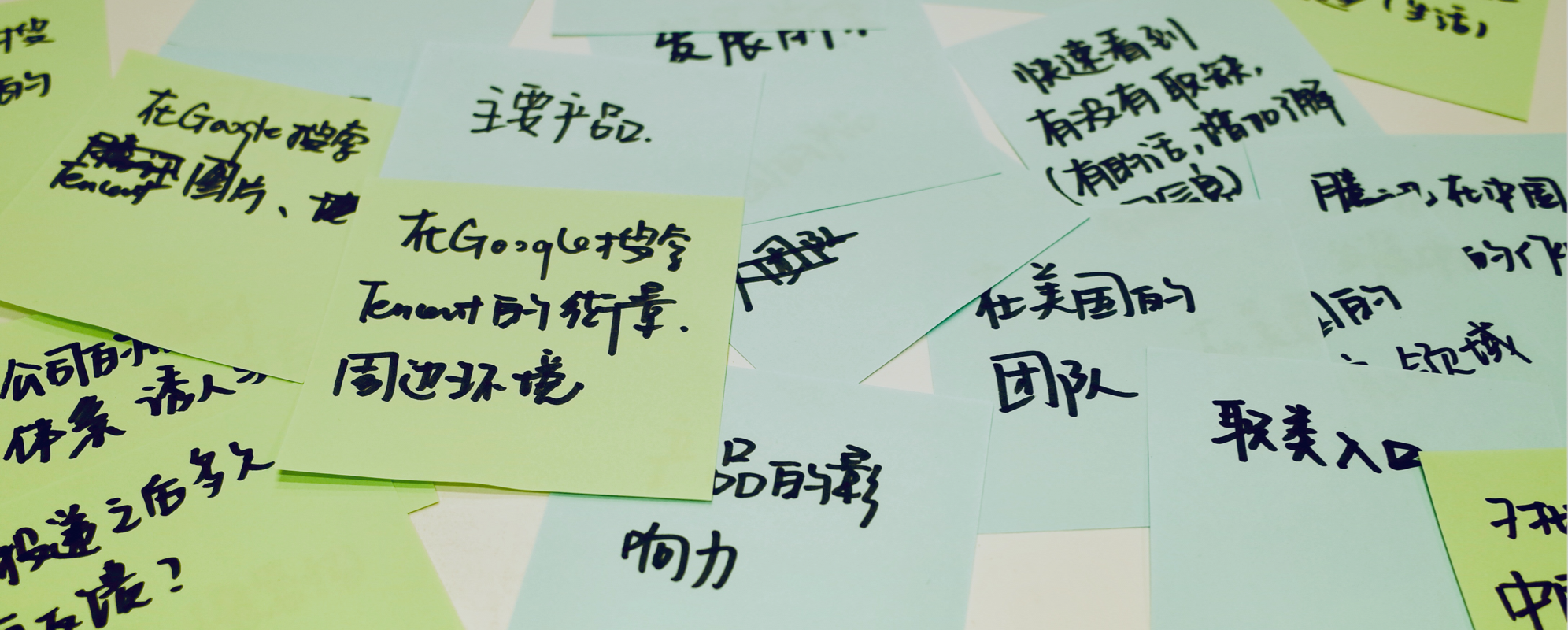
During the define phase, all ideas were required to be written on the sticky notes and shared with each other which are uncommon in previous work. Then, we invited team members to classify these notes. Acceptance by most of the team members is the foundation. Classification is the first card sorting in this project, so so-called affinity graph, therefore, we got an agreement on information architecture.

The Affinity Maps
Develop
Designers mainly focused on two things, inviting stakeholders to finalize the concept to be prototyped, and pushing other related teams to update content.
The reason we asked stakeholders to come to finalize the direction at this time is that reaching a clear consensus by co-creation in a cross-functional team is necessary at every decision-making stage. As we came to the solution of information architecture and framework with opportunities discussed in the journey map, we created a new prototype.


The Prototypes
The shortage of content remained the toughest challenge ahead of our team.
We have a clear direction for Life at Tencent which would be an all-in-one introduction including attracting comprehensive life, culture, and benefits. In the old version, the category of this part literally depended on the structure of the organization and its responsibility, not to mention the visual cliché. It seems to imply that modification of this part requires cross-functional collaboration, and truly it is. Multi-teams involved - such as the culture team, benefits team, legal team, and administration team - often lead to a tricky decision. In order to solve this problem, our design activities need to engage with a third-party perspective which is user-oriented.
Making an understandable list of terms including the category of facility, life, salary, benefits training, etc, we selected twenty candidates at random via distinct job channels at both campus recruitment and experienced the recruitment process to participate in open card sorting. The cross-functional team could know the patterns that our users classified these terms by calculating the co-occurrence matrix of these two types of users and analyzing hierarchical clustering. As long as we get this report, we can push the redesign forward.

Card Sorting
Besides, with the core team, designers boosted the re-classification of the job category which is under the charge of Tencent Academy. Not only graininess of the old job category is coarse, but also inconsistent terminology in JD posts, we hope that the new job category will help candidates find jobs quickly that match their professional experience perfectly. The difference in card sorting between the Life at Tencent and Job categories is the former is user-friendly to understand, but the latter requires professional knowledge to understand terms. So, in the latter case, we invited recruiters instead of users to conduct closed card sorting.
What’s more, content strategy is still on the way, for instance, voice and tone, pictures and videos, subtitles and dubbing, web components, email templates, advertisement format, legal documents, etc. We hope that Tencent Career is committed to connecting the candidate with Tencent. In order to achieve this goal, the contents need to be authentic, friendly, and dynamic. In this phase, the headquarters recruitment team is responsible for collecting, organizing, and generalizing the content types as well as design team provides templates and principles, at the same time, we’ve offered translation vendors aboard the standards of localization.
Delivery
The develop and the delivery are actually iteratively updated. For instance, the proposal after the prototype, the finalization of the job category after closed card sorting, the review of content after production, the usability after the beta version, etc.
Based on the sketches, the design team worked with the recruitment team to produce a low-fidelity prototype and then came up with a design proposal, including the architecture information, content, visual tone branding, etc. Incorporating the new suggestions of the head, helped us validate the concept at this stage.
20 recruitment managers were invited to conduct closed card sorting based on the designation of the job category to verify the validity category.
Usability testing was performed before launch.
We found that under the situation of semantic consistency between Chinese and English - JOBS versus 工作机会, as well as STUDENTS & GRADS versus 学生 - CTR of the experimental group is lower than the control group. In the experimental group, we translated JOBS into 工作机会 as well as STUDENTS & GRADS into 学生. In the control group, JOBS into 社会招聘 as well as STUDENTS & GRADS versus 校园招聘.
In addition to this, the visual design of the search is not very obvious and has been optimized through usability testing.


Release
After one month of release, we have more than 12,000 registrations in a month without a marketing campaign. The resume count was double times that of the old version month-on-month through the optimization of login and application processes. The newly released version has lower registration costs than ever. Also, the duration increased by 22% through information enrichment.
Besides, our website’s MAU has reached 520,000 which has grown 65% month-on-month, and daily page view has over 60,000, which has grown 30% month-on-month.
The new release provided a more comprehensive and consistent employer brand and a more friendly candidate journey for those who want to join Tencent at home and abroad. Design helps candidates to know Tencent more, and to know himself or herself better.
© 2024 Xiang PENG. All Rights Reserved.