
Yunyou Dunhuang Product Design
2020|Type: WeChat Mini-Program, Platform Product|Tag: Design Led|Roles: Product Lead, User Research, UX Design, Project Management
Background
To strengthen collaboration between Tencent and Dunhuang Research Academy (DHRA), Tencent plans to launch a Mini-Program project for visitors to the Mogao Caves. The initiative aims to enhance preservation, research, and promotion with DHRA.
Effect
The Mogao Caves closed on 23 January 2020 due to the pandemic. However, on 20 February 2020, the WeChat Mini-Program was launched, and within just ten days, the number of users exceeded one million. On 10 May 2020, the Mogao Caves reopened, and the number of visits reached 13.6 million, 6.3 times the number of tourists in 2019. The success of the WeChat Mini-Program highlights the potential of online tourism and the importance of cultural preservation. More people are now paying attention to cultural preservation, thanks to the availability of high-quality online cultural tourism. As of 31 August 2020, the number of users reached 4.3 million, and the peak monthly active users was 1.83 million. The program has been hailed as a benchmark for cultural preservation in the industry and has opened up a new direction for promoting culture through online tourism.
Tencent, the company behind the WeChat Mini-Program, received positive evaluations and cultural recognition that exceeded historical highs. The state also recognised Tencent’s efforts in digital cultural preservation by awarding them the 2020 Chinese Cultural Relics All-Media Communication Excellence Award, which is a significant milestone in the field of digital cultural conservation in China and the world.
View the project on Slides
How do we make trade-offs between heritage preservation and tourist experience?
In the past, visitors could purchase tickets a month in advance to visit the Mogao Caves and explore eight caves. However, with the advent of Digital Dunhuang, online visitors can now browse through thirty classic caves and ten murals from the Mogao and Yulin Caves. Today, Dunhuang culture is at your fingertips—you can explore 1,800 murals and 210 sculptures from 231 caves across five archaeological sites around Dunhuang without leaving your home. This is Yunyou Dunhuang.
Research
Given the significance of the Mogao Caves, it's essential that we provide visitors with the best possible services. Some people propose guided tours, while others suggest cultural and creative products. As a partnership product, the first step is to understand the ideas of the stakeholders. The main stakeholders include the Institute, Tencent, and tourists.

Dunhuang Research Academy (DHRA)
To answer this question, we undertook an investigative trip to Dunhuang and Lanzhou, visited a dozen organizations, and conducted fourteen in-depth interviews. Each organization is specialized in its field. By the end of the research, more than half of the organizations had not been visited. Additionally, we ran a competitive analysis on twelve cultural products in the areas of preservation, research, and promotion, collected more than five hundred questionnaires, and sorted out user journey maps from the offline experiences of tourists.
Through in-depth interviews, we found that the digitalization of the institution’s products varied, and the panoramic resources became data silos. The services provided by the organizations were scattered across platforms and were not connected to each other. There was also a shortage of social funds and a lack of attention to public welfare.

The Insights of the In-Depth Interviews
Through competitive analysis, we found that many foreign cultural and museum organizations offer public resource libraries, but there are relatively few such libraries in China. Furthermore, the existing resource libraries often lack relevance to users, and those with high-quality images can significantly enhance the user experience.


The Screenshots of Relevant Applications
Through the lightning talk, we learned that the company aims to highlight Tencent's cultural technology while developing a new cultural and creative strategy. This strategy emphasizes the cultural value of intellectual property (IP) and focuses on showcasing partnerships.
Regarding the survey on the "Mogao Caves Tour Experience," we collected 507 responses. We found that 90% of visitors were deeply moved during their visit to the Mogao Caves. Eighty percent felt that protecting the Mogao Caves is extremely important after their visit. Seventy percent were willing to donate to the digital conservation of cultural relics in the Mogao Caves. More than 60% expressed a desire to learn about the Mogao Caves from a different perspective, and over 50% were unaware that the Dunhuang Academy offers individual research courses.
Through the user journey map, we identified that the visitor experience is fragmented. Specifically, there is a lack of a unified channel for knowledge and a publicly accessible knowledge catalog prior to the visit. During the visit, visitors struggle to remember the caves they have toured, and photography is prohibited inside the caves. After the visit, memorable moments are not captured or recorded.

The User's Journey Map
Based on the information gathered from the initial survey, a question emerged: Are these visitors the same individuals at different stages of the product life cycle, or are they distinct groups? Those who show interest in the Mogao Caves are likely to be online users or paid course participants. In the future, they may progress to visiting the Mogao Caves in person, becoming passionate nonprofit activists, or even academic researchers.
YunYou Dunhuang is a user-centred cultural tour that helps users explore, visit and conserve the Dunhuang Caves online.
Solution
For now, what can we do for DHRA and visitors:
- Improve elementary experience by building an online media library, promoting preservation, and increasing referral traffic for DHRA.
- Promote culture by accumulating more and more co-creation projects for collaboration with DHRA.
- Attract social funding by encouraging donations within creative projects for China Dunhuang Grottoes Conservation Research Foundation.
Integration of digital assets from ideation to commercialization in culture and tourism is the first step we’ve tried. Furthermore, we also try to improve efficiency and optimize allocation in the chain to fill service gaps in this industry.

The Solution Needs to Meet the Users’ Needs
Value Proposition
‘YunYou Dunhuang is a user-centred cultural tour that helps users explore, visit, and conserve the Dunhuang Caves online.’
Product Objective & Strategy
Based on this situation, we devised a solution that provides a cultural tour for visitors to explore, visit, and conserve the Dunhuang Grottoes online, consisting of a user-oriented Mini-Program and a content management platform for DHRA and its partners. A labelling system based on intent, behaviour, and grottoes knowledge linking users to the caves, helps DHRA understand user portraits and prepare a solid foundation for further delicacy operations. Visitors can obtain the most complete and most dimensional knowledge of Dunhuang at any time or anywhere through this Mini-Program. And, DHRA could have a package deal that integrates construction, operation, and effect tracking through this content management system.
The objective and strategy as user-oriented could be as follows:

How Do We Build the Objective and the Strategy
Product Architecture
Our product architecture is based on the general direction of the product.

The Service Blueprinting
Yunyou Dunhuang Wechat Mini-Program
Backgound
As can be seen from the product architecture, this MP provides an online media library, access to services, and preservation knowledge for visitors. Access to the services including ticket purchasing, offline course booking, tour guide, etc that offer an all-in-one solution for DHRA. Preservation promotion starting from mural diseases as well as cave microenvironment leads visitors to pay attention to cultural heritage preservation and donations. The main focus of the design is how to build the online media library and how to help visitors easily understand the knowledge of Dunhuang Caves.
Problem
Online visitors could visit thirty caves through Digital Dunhuang, offline visitors could view the introduction from the entrance of this grotto through a QR code. Researchers could read journals in the Dunhuang Academic Resources Database which has a strong professional background that results in a low acceptance of tourists. In summary, visitors encounter problems including multiple channels, less structured information, and decentralized services while searching the knowledge of Mogao Caves.

The Touchpoints: Scan the QR-code to Get Information of Caves
Solution
Understanding the problem, the first thing we can try to do is digitalize libraries, connecting caves with tourists through cultural resources.
Design Analysis
Knowledge of the Mogao Caves activates the interest in offline visits and the responsibility to participate in heritage preservation.
- Offline: Get to know the Mogao Caves you've visited quickly, check them at any time, and if possible, remember the eight to twelve caves you've been to.
- Online: The general visitors begin to generate interest in the Mogao Caves, while the professional visitors have a way to learn more about the Mogao Caves.
Design Objective
- Lower the threshold: Encourage general visitors to have an initial interest in the Mogao Caves and begin to have an initial relationship.
- Quick start: Enhance the impression of the Mogao Caves and generate motivation to explore
- Deep discovery: Strengthen the emotional connection between the individual and the Mogao Caves by exploring vividly.
- Take action: Go and visit, and start to care preservation of Mogao Caves.

The Summer Camp of Students in Dunhuang
Information Architecture

Information Architecture
Design Strategy and Delivery
Lower the threshold through selected murals and living interpretations.
- Dunhuang Quotes: A daily selection of murals and wise phrases are provided to users. The first is to interpret the mural connotations. Getting users to start taking an interest in the caves and building an initial relationship; the second is to become friends with the users. Carefully record every day of their lives. When users share their past Dunhuang Quotes, we change the date to ‘past’, hoping to convey the idea of ‘living in the moment’, which is a small design idea.
The Dunhuang Quotes
Quick start for users through bite-sized delivers such as mural recommendation, mural story, and mural disease introduction through exploration, visitation, conservation, and creative stories tabs. Let's take a look at the overview.
How Do We Know the Caves Fast & More
Marking caves, and collecting murals to discover culture and arts deeply through category, open status, and micro-environment.
- By category: Map the information and labels of murals, sculptures, and caves to the pictures.
- By dynasty: Present caves by dynasty.
- By colour: Map mural colours recognised by the system to the colour range.
- By open status: Associate caves with different status.
- By micro-environment: Present temperature and humidity of caves.
By Category (Mural)
By Dynasty
By Colour
Encourage users to take action, plan a trip, and participate in protection through digital donation projects, tickets, and course booking.
- Digital donation projects: Accumulate public welfare projects and raise social funds for the foundation through creative projects.
- Booking: Provide all-in-one trip experience including tickets, guide, and all kinds of courses.
- Digital conservation: Provide panoramic view and virtual reality through Digital Dunhuang.
Yunyou Dunhuang Content Management Platform
Backgound
The main task in a content management platform is to continuously generate resources for content that could be explored in a mini-program. Generally, resources could be divided into two types, the basic type, the other is operation type. The long-term goal is to build a content management system that integrates generation, operation, and effectiveness measurement. The primary task at this stage is to provide basic resources.
What are the basic resources
Take Mogao Cave No. 254 as an example. This is a central pillar cave from the Northern Wei Dynasty. We can see a thousand statues of Buddha, a quadruple arch, and a statue of Buddha. This corresponds to the three layers of the cave's structure, mural, sculptures, and cave architecture.

The Three-Tier Structure
Digital Dunhuang provides these dimensions: region, cave number, cave form; mural name, mural dynasty, mural description; sculpture name, sculpture dynasty, sculpture description, and so on.
On this basis, we have sorted out the knowledge structure of Dunhuang caves through three sets of books, the 26-volume Dunhuang Book, the Dictionary of Dunhuang Studies, and the General Catalogue of Dunhuang Caves, to provide a more comprehensive and multi-dimensional knowledge base for the visitors from a wider range of scenarios.

The Dimension of Caves
The properties of the added attributes address many problems:
- Difficulty in category
- Incomplete information on orientation
- Lack of professional research on colors
This is how we solved it:
- Firstly, flexible configuration of categories, we defined category management in the backend and centrally configured a total of 271 attribute tags for murals, sculptures, and cave architecture.
- Secondly, exhaustive orientation, analyzing the shape of the caves and complementing the orientation.
- Thirdly, the bi-colour distance, after determining the extreme value of the Dunhuang colour point with the professors, the distance between the screen colour picking point and the Dunhuang colour point is measured in the three-dimensional coordinates of HSV to determine whether it is within the range or not.
- Fourthly, a labeling system was also built to solidify the foundation for subsequent refined operation.

The System of Labels
How to process the basic resources
Searching in the library so far, we’ve found that three sets of books could satisfy our demands, which are the 26-volume Dunhuang Book, the Dictionary of Dunhuangology, and the Great Catalogue of Dunhuang Caves. However, the defect is all of these books are scanned PDFs. Besides, the structures of these books are different, photo-text type, dictionary type, and dictionary type with distinct menu.
Considering that the contents of the 26-volume Dunhuang Book and the Dictionary of Dunhuangology are too much to process at one time, therefore, the flow of book correction and picture upload is customized for these two sets of books, including OCR recognition to text, text correction, picture upload, labeling, descriptions association, etc.
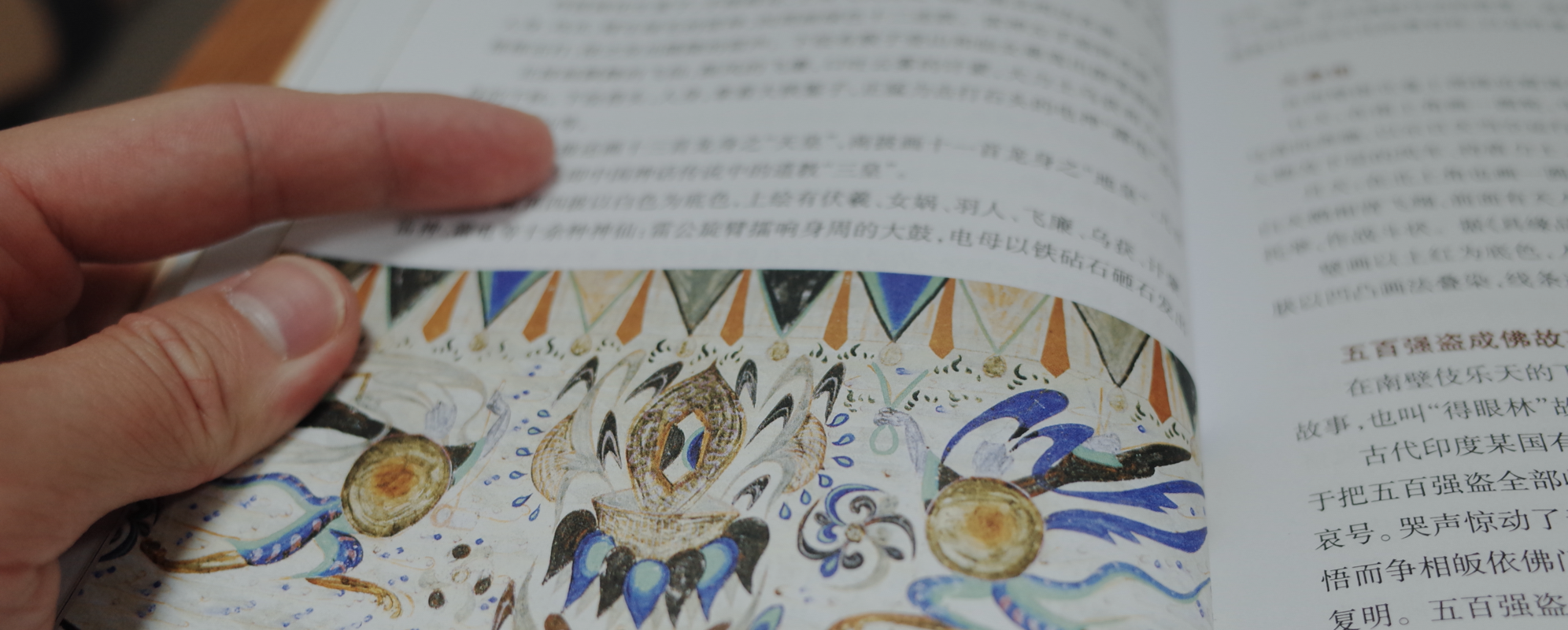
The Paper Books
Text Information
Back to this picture. The information is provided by three sets of books, and the books are all scanned PDFs. the content is unrelated and text-heavy. Here's how we solved it:
- First, build a catalogue path for the book's custom book upload, identify the catalogue, and correct the catalogue process, for the subsequent associated images provide a path.
- Second, paragraph interception recognition. Through the screenshot, OCR recognition and manual correction, to reduce the manual input of text errors.

The Information of Books and the Dimension of Caves
Picture Information
Take Shibi Jataka as an example, a mural painting of Mogao Cave No.254 on the north wall west side. The name of each image contains tag information, and you can also see some of the category information.

Information obtained from the Name of the Picture
Several other mural paintings in Mogao Cave No.254 also fall into the category of Shibi Jataka, but the size of the images varies greatly.
In addition to this, there are Sutra Transformation Paintings. As the name suggests, turning sutras into paintings is usually a long painting with insufficient resolution after cropping.

Pictures in Different Sizes
These cases of many paintings, many labels, different sizes, and insufficient resolution, this is how we solve them.
- Firstly, automatic acquisition, after the picture is uploaded, the name is automatically recognized and the label is matched; manually it can be modified and associated with the entered text information.
- Secondly, in batch actions, the picture category is not a package deal, but each conclusion can be quickly modified through the picture categorization.
- Thirdly, size pre-cropping, to meet the different specifications of the presentation.
- Fourthly, tag intervention, through the label such as horizontal-long-picture, the picture is not suitable for mobile presentation filtering.
By this point, the hardest part of the digital build has been tackled.
The three sets of books all have a lot of work that requires manual processing. DHRA may not have enough staff to support this work, so new partners need to be introduced to complete this part of the work. In addition, it also needs to provide functions such as authority management for the partners and DHRA.
In addition to the above section, we also did:
- Reduce the cost by auto recognition and batch behaviour.
- Search pictures by multi-dimension filter and approximate string matching.
- Build content operation within existing experience activities, users could conduct CRUD based on the actual situation of the attractions.
- Visualize the basic metrics.
Below is the information architecture diagram of the content management platform.

Information Architecture of the Content Management Platform
Design Strategy and Delivery
In the book library, the manpower cost of entry and modification is reduced through automatic identification and operation in batches.

The Library of Books
In the image library, help users locate images through multi-dimensional search and fuzzy search.


The Library of Pictures
Help users update offline services in an all-in-one solution, add, delete, and check according to actual needs.


The Solution for the Offline Services
Gains and insights
As the design lead for this project, other roles were undertaken, including:
- Responsible for user research, leading in-depth interviews and questionnaires;
- Responsible for the UX design of the WeChat Mini-Program to ensure user experience;
- Responsible for the product planning of the content management platform, writing documents, and guiding the design;
- Responsible for project management, repeatedly reporting to President Zhao Shengliang and Party Secretary Ma Shilin on the program and work progress; promoting collaboration between the Institute, Public Relationships, designers, R&D agency, and content agency; reviewing content, design, and code; launching campaigns and expanding design influence.
These experiences have led to a lot of growth, especially in communication skills and project management, one makes me understand that design cooperation across corporations is the multiple games of maximizing community value; one also makes me stand in different roles of the team and think about the same problem in a real way. At the same time, I also see my shortcomings. For example, it's hard for one person to balance making things broad and making things deep.
If digitization has made Dunhuang culture more open, then design challenges at the scale of the product and likewise make designers more confident.
In the future, I will still take this confidence and continue to try new roles and explore new areas in depth.
© 2024 Xiang PENG. All Rights Reserved.