
Integrated Design of Data Management Platform
2021|Type: Platform Product|Tag: Design for Service Improvement|Role: Product, UX Design
Background
In the context of the overall deep ploughing of the industry in the ad network, the understanding of industrial features within one user is particularly important. We have delivered the value proposition of the entire scene and conversion paths by upgrading the platform. The challenge for the designer is to deliver the solution within one week.
Value Proposition
We take the user as the core to build an in-depth understanding of the industry, integrate the data capabilities of the entire scene, connect the data for advertisers from public to private domains, lead to deep conversions, and impel the long-term development of the business. Specifically,
- Entire scenario. Integrate news data, social media data, search data, and others to help advertisers glimpse the whole picture of business.
- Intact conversion path. Combined with the first-party data of advertisers, we help amplify the value of advertisers' data, connect the data from the public to private domains, and build digital marketing in the life circle among Pre-Ad, in-Ad, and Post-Ad, which effectively builds digital assets and contributes to the sustainable growth of business.
- Deep conversion. Deeply explore the value of the first-party data, through industrial differentiated data services to enhance the effect of the conversion and help achieve business objectives.
Objective
Integrating platform features, shaping new brands and expanding influence by promotion.
How to integrate platform features?
Research
In 2020, Zhishu (formerly DMP) continued to build its data ingestion and federated modelling features and has won success with some of its key accounts. Now we expect to open these features to more advertisers. However, the following problems exist at present, and there is an urgent need to upgrade the platform.
- Both data ingestion and federated modelling features have higher requirements for data security.
- The addition of new concepts creates problems for advertisers and is not conducive to the build and maintenance of a brand.
- The public definition of Tencent's advertising DMP does not match the actual data features.
It has been a year since DMP's last overall migration, and DMP has gone through as many as seven designers throughout the migration process. The migration process dropped many problems: each designer was involved in part of the process, and the previous designers did not have a design system as a standard, resulting in a platform with poor consistency in user experience, specifically, a lack of consistency in the selectors and spacing specifications, to the page and flow templates, and the design patterns.
In addition, as the DMP was previously built by different product teams, there was a lack of global perspective to understand the whole scope, and facing this upgrade with limited time and resources, the designer only had one week to find and refine the service gaps. Although time-consuming, the journey map is still a worthwhile way to try, not only to reach a consensus quickly but also to guide the product team to sort out the to-do list and priorities of the platform upgrade.

Friction and Opportunity
Version
Analysis
There are two general ways of dividing product versions in the market:
- Artificial division. According to the positioning of the product, the whole is divided into different versions.
- Based on some kind of hierarchical rules. For example, each feature is activated according to the cost of advertisers.
After discussion, we chose the artificial division approach for two main reasons:
- First, this upgrade is for the advertiser team, and the users have newly introduced modelling engineers in addition to the previous ad delivery optimizers. In terms of users, there is no demand for gradient splitting.
- Secondly, the platform temporarily does not measure each feature according to a certain grade, and it is not possible to make a reasonable distinction in the short term.
Solution
Based on the advertiser's industry and data infrastructure, we distinguish three major product versions to provide open framework data services based on conversion.
- Basic Edition|Zero thresholds, one-stop operation
- Professional Edition|With data analysis and modelling
- Private Edition|With Data Structure, Algorithm, and modelling Engineering
In basic edition, Provides standardized data mining and insight tools with efficient and secure data access. In addition to the Basic Edition, we provide an open framework with data application tools such as industry insights, autonomous modelling, and deep bidding in Professional Edition. In Private Edition, Open framework, private deployment, expert customized mining, serving private scenarios.
Information Architecture
Analysis
Sorting out the information architecture is at the centre of all the to-do lists, and the other to-do lists, as well as marketing promotion, are all dependent on the new information architecture.
Federated modelling, which includes Data Map, SQL Lab, Model Lab, Rule Lab, and RTA Lab. Five major features are currently serving the key accounts, and the main users are modelling engineers. The non-federated modelling users are mainly ad delivery optimizers. If the existing whitelisting is directly opened out, the concept of federated modelling is bound to confuse optimizers. What are they respectively? In what scenarios should I use them? What is the relationship between them and the DMP? This is not conducive to the build and maintenance of a brand. Before dismantling the federated modelling, we need to understand what is federated modelling.
Federated modelling is an integrated product that provides a secure and controllable data marketing strategy tool with high autonomy and flexibility, specifically:
Data Map: Accesses and extracts data through library and table, visualizes the first-party data and second-party data.
SQL Lab: Provides an integrated programmable environment to help users with self-service analysis and extract the audience files based on the analysis results, which can be used directly for ad delivery or further data processing.
Model Lab: Builds a simple modelling platform to help users train and predict by using first-party data and second-party data as inputs, and extracting the audience files based on the prediction outputs.
Rule Lab: Adjust the bidding price strategy based on the audience rule, in which the audience can be the audience files, labels, or positive and negative samples. This strategy directly affects eCPM in the ranking phase and the scoring phase.
RTA Lab: Exclude the audience by the ad account, the ad, directly.
It is easy to find that federated modelling is a complete set of data marketing solutions from data ingestion, data analysis, and machine learning, to data strategy, audience extraction or advertising, and other key actions.
The main capabilities of the non-joint area include labelling populations, extracting populations from data sources, combining populations by intersecting and combining differences, and so on;
The features outside federated modelling include the label audience, the condition-extracted audience such as the data source-extracted audience, and the grouped audience by calculation of intersection, concatenation, and difference. Besides extraction, we also support insights, audience expansion, and audience separation.
The audience and the data sources belong to the advertisers, the complexity of the account and the necessity of assets’ authorization require the restricted management of the audience and the data sources. Then we have:
Managing data from the audience, data source, and data map by customer asset dimension, focusing on the asset attributes of the data.
The grouped audience, the label audience, the condition-extracted audience, and the predicted audience by the model lab, focusing on data mining.
The audience insight and SQL lab, focus on analytic capability and insights.
The rule lab and RTA lab, as the audience strategy that directly affects eCPM in ranking and scoring, focus on the strategic application of data.
Analysis from the role of the user:
- Business Decision Maker: responsible for advertising goals and strategies.
Portfolio Manager: responsible for data asset access and authorization.
Data Analyst: responsible for data analysis and processing.
ML Engineer: responsible for data mining, modeling, and strategy design.
Marketing Specialist: Responsible for ad delivery and audience processing.

User flows among Different Roles
Solution
Based on Tencent's deep insights into people and industries, through the four major workstations of assets, insights, mining, and strategy, it provides various roles in the enterprise with a relatively independent collaboration and deeply participates in the application of data in advertisements to drive the maximization of efficiency.

Information Architecture
In addition to this, there are some pending features to be built:
- Industry insights: customized insights have been contracted with some branding advertisers in the form of an annual protocol, providing industry insights for several industries.
- Message Center: message reach within the platform is solved manually or through components after, failing to solve the problem automatically.
Overview
Analysis
When communicating with customers, they often use some metrics with statistical meanings to describe the usage of DMP, such as how many audience files are available under this account, how many are self-built, how much data is accessed by the data source, whether the reported data is available or not. This reflects that the old DMP lacks a pivot table of the platform.
Considering the new information architecture, we have attempted to disclose the underlying metrics, usage, and industry recommendations that we are currently able to distil by asset, insight, mining, and strategy.

Explore what can be disclosed on the homepage
Solution


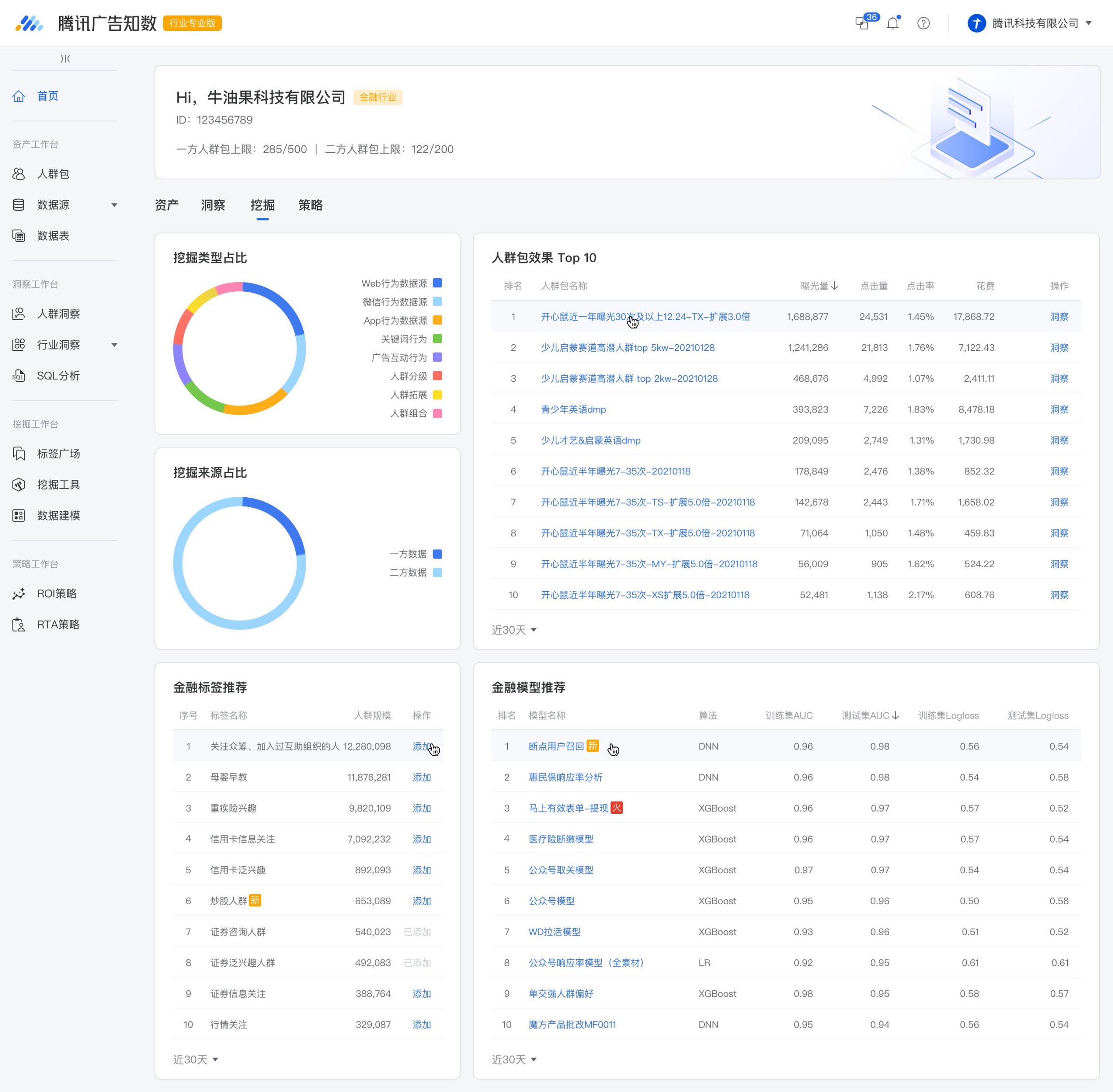

Homepage
For the strategy overview, a user-friendly introduction has been designed since new account holders must not have content.


for New users
Open an Account
Analysis
A unified upgrade of the platform will bring a lot of wasted resources, for this reason, it is necessary for the advertiser team to independently apply for whether to choose to upgrade and which version to upgrade to. We will expand the intuitive differences of each version through horizontal comparison to help users establish an understanding of the industry’s professional version.
Solution


Side-by-Side Comparison of Version Differences
New Users Guidance
Analysis
Two new user guidance have been designed based on the Basic Edition and the Professional Edition respectively. However, the purpose of the introductions in the two versions has its focus:
- Basic Edition: highlights the migration of features and changes in location.
- Professional Edition: highlights the new capabilities added.
Solution


Basic Edition


Professional Edition
First-Time Use for New Users
Analysis
The majority of these features are served for modelling engineers, but the users who come in are not necessarily modelling engineers. To let the product speak for itself, a standardized first-time-use flow was created to help users clarify what problem these features could solve and how many steps can be taken.
At the same time, a standardized first-time-use flow was added for non-changed features.
Solution
In addition, this upgrade also updated the documentation of the product document, replaced the old wording, filled in a lot of empty states, and began to sort out the consistency of the entire platform, to ensure that when users come in, they can feel the consistency of the different main pages have improved. Of course, the consistency problem still exists, and it depends on the subsequent product iteration to continuously optimize each item.


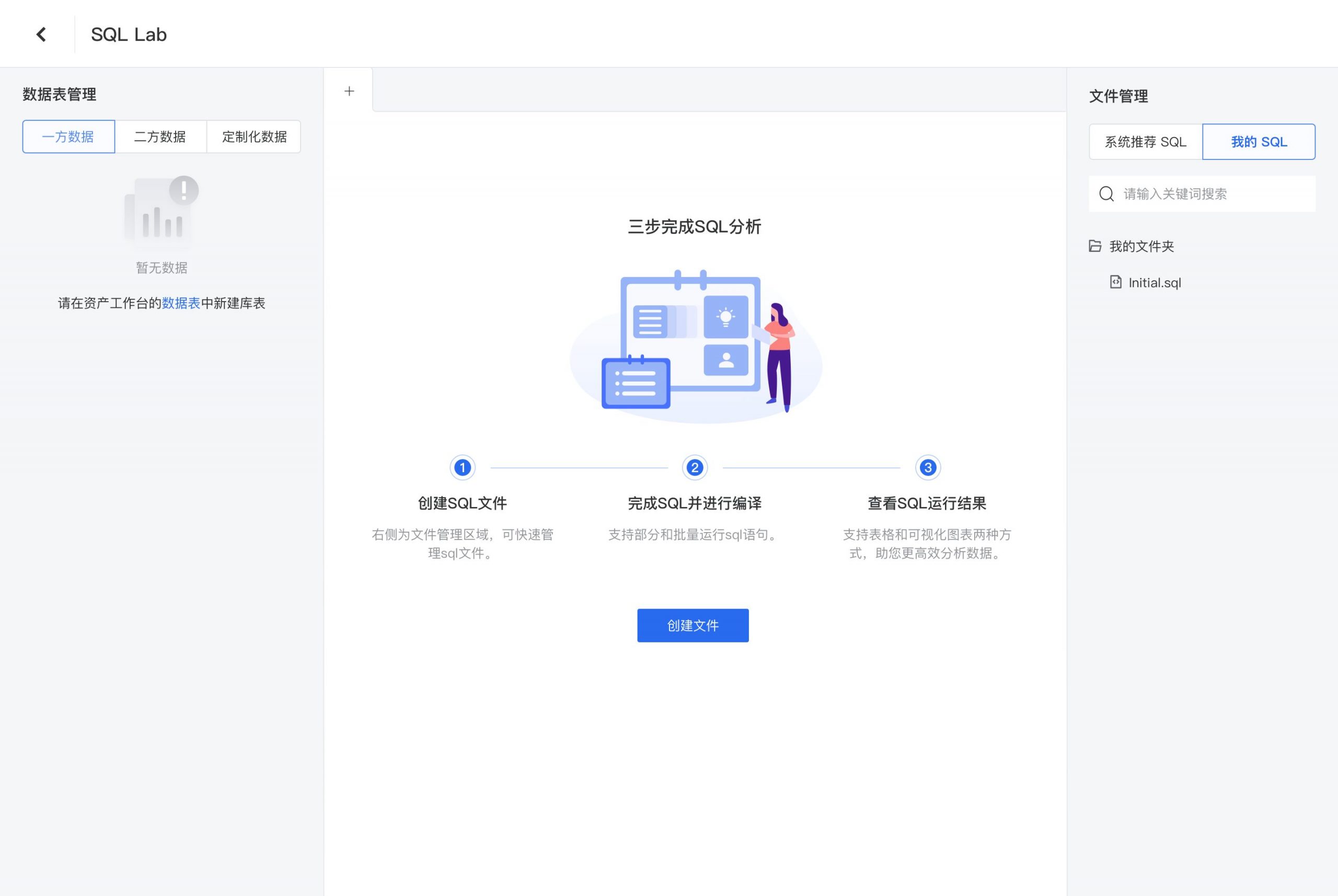


Completes the first-time experience for new users
Specifically, for the sharing of second-party data of Tencent Ads, it would take roughly 10 business days to stream 30 days of data back to the platform at once, which is a poor experience. We have phased the data reflow, initializing some of the data so that users can use it for a short period, and then loading historical data continuously.


Performance-Based Design Thinking
Last but not least
In this upgrade with limited time and resources, the product manager is more focused on solving the customer docking, market promotion, and the back-end modification of important features. The upgrade of the front end of the platform, on the other hand, naturally fell to the designer. In the whole promotion process, we encountered many non-technical problems: limited time, almost every page updates, R&D research, seven designers in one year, resulting in a mess of historical documents, and the platform has no design guidelines that can be referred to, so the difficulty is self-evident.
Although there are still a lot of inconsistencies in the user experience of this platform, in the process of upgrading the platform, we tried to solve some of the historical problems brought by the organizational structure, and we also tried to collect the first impression of users into a more consistent feeling through the means of new users guidance and first-time use flow. At the same time, we also launched a special consistency project to gradually iterate the consistency of the platform in terms of pages and components, presentation, and operation.
© 2024 Xiang PENG. All Rights Reserved.