
Lite Insights on Comparison
2020|Type: Original|Tag: Experience
The Benchmark of Comparison
Comparing with whom is the first question we are concerned about. In the market, we can point out very clearly who our competitors are through analysis of the strengths and weaknesses of our opponents. However, black box products cannot tell you directly who your competitors are. In this condition, we need to build our benchmark. We think the following five benchmarks may be suggestions:
- Itself: Compare it to yourself.
Its family. That is, all objects other than itself, have the same attributes and belong to the same category. For example, the same authentication system, the same account system, the same setting group, et cetera.
Similar object. Objects that have a high degree of consistency with their objects under a certain rule. Such as simultaneous, similar, popular, etc.
- Industry in which itself is located (levelled, quantile) . Levelled. This refers to the first level, second level, third level, fourth level of industry, et cetera., in which it is located. If it is already the top benchmark of a level of industry and does not compete with the level itself, then an upgraded level is recommended. Quantile. This refers to the position in each level of the industry that has a reference value, such as the first quartile, the second quartile, the third quartile, the average, et cetera., or even a customized benchmark. The choice of reference value depends on the data. If it is in an unfavourable position in one level of the industry, it is recommended to select the appropriate benchmark in the current industry as a reference.
Market. That is the largest range of comparisons. By comparing the whole market, you can get a clear idea of where is your positioning. The whole market may also have a benchmark, which refers to a reference value in it.
In addition to this, in the long term, we can set different ranges of competitors for further study. In the short term, we focus more on real-time competition.
The Period of Comparison
Isolated data is not very instructive, the period is the measure of which we study for. Based on the reference system, analyzing itself, we can rely on different periods, such as yesterday, periods such as a week, a month, a year, the last 3 days, the last 7 days, the last 30 days, the last 60 days, et cetera.
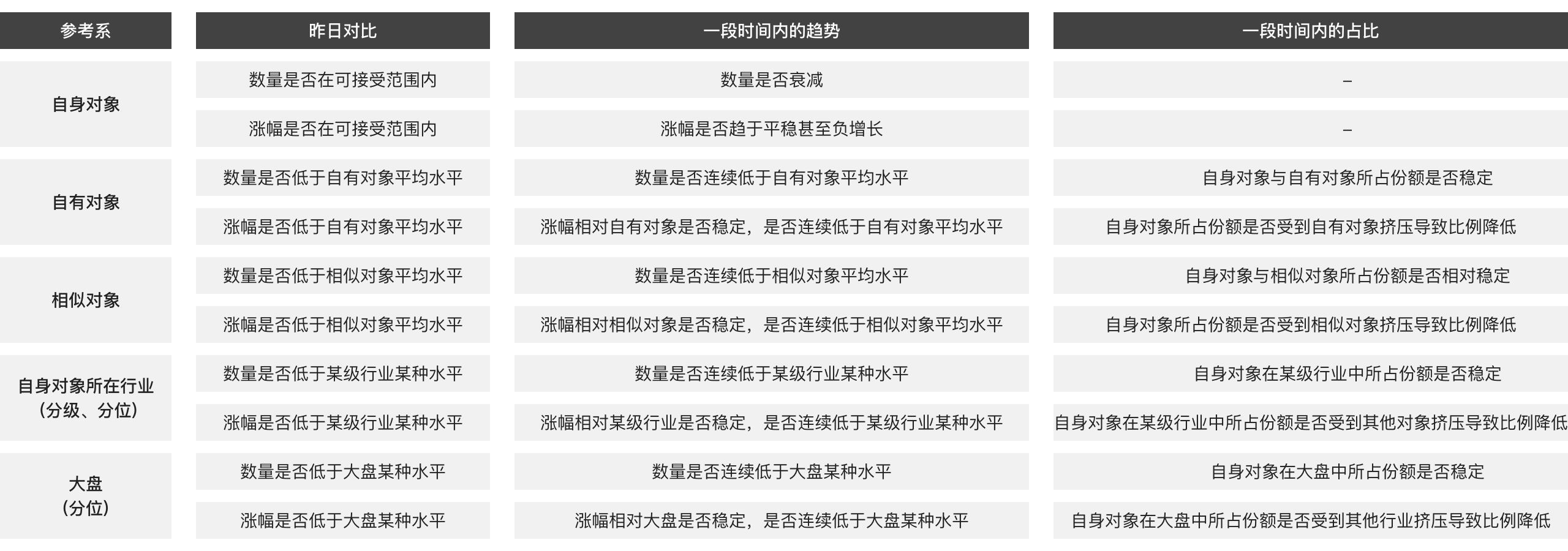
Take Its family as an example:
- Compare to yesterday: Whether the quantity and the rate are lower than the average for its family
- Compare to a period: Whether the quantity is continuously lower than the average level of its family, whether the rate is more stable and continuously lower than the average level of its family
- Percentage over time: Whether the share of it and its family is stable, whether its share has been squeezed by its family, resulting in a decrease
The Factors of Comparison
Factor decomposition is carried out according to the conversion paths, organization and so on. From a macro view, it can pinpoint micro issues more precisely.
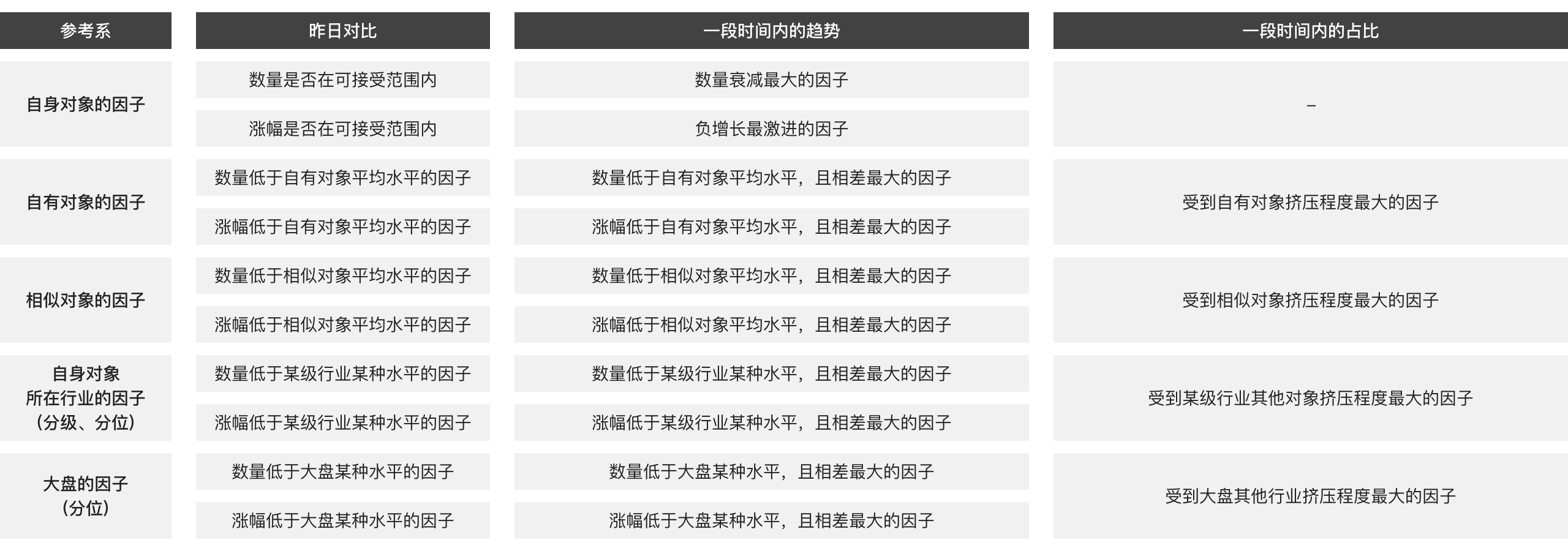
Take The factors of its family as an example:
- Compared to yesterday: The quantity and the rate of the factor are lower than the average for the factors of its family
- Compare to a period: The quantity and the rate of the factor are lower than the average for the factors of its family and with the largest difference
- Percentage over time: The factor that is squeezed to the greatest extent by the factors of its family
Explicit and Implicit Comparisons
The question of what form a comparison-based product is designed to take is one that deserves some thought. It can exist as a high-level architecture or as a locally adapted strategy under specific features. As architectures and strategies are explored and applied, a common standard system can be gradually established as well as a benchmark reference for various industries. At the same time, it can also establish Kanban information for users to provide effective reference.
- As an architecture: Comparative Analysis and Competitive Analysis are common forms of products that provide interactive operations and analytical modules. When the range of reference systems is large, it requires a certain amount of data processing, so it often exists in the form of a task flow.
As a tactic: Enhancing purchasing persuasiveness, and increasing confidence are its common goals to persuade users to use a particular feature in a specific scenario by pop-over guidance and so on.
As a standard system: Based on business metrics, distilling credible, usable, and valid information from the 'Reference System' ✕ 'Cycle' ✕ 'Factor' is the basis for building a standard system.
As a benchmark: The benchmark for the same standard system may vary very much from industry to industry. It depends on the experience of each industrial specialist.
- As a Kanban: Provides information embedded in the graphic of most interest to the user.
© 2024 Xiang PENG. All Rights Reserved.